The bit of your business plan you forgot is you
Sep 24, 2026 The bit of your business plan you forgot is you. Not your cash flow forecast, not your marketing funnel or your five-year growth targets, but the actual person expected to deliver all of it, day after day, on whatever sleep and patience you've got left. Somewhere along the way, hustle culture got glorified and female founders got told that pushing through exhaustion is a personality trait worth having. As a founder and health coach myself, I strongly believe it isn't. Chronic stress isn't a badge of honour. It's a warning sign dressed up as productivity.
Why resilience has become another chore
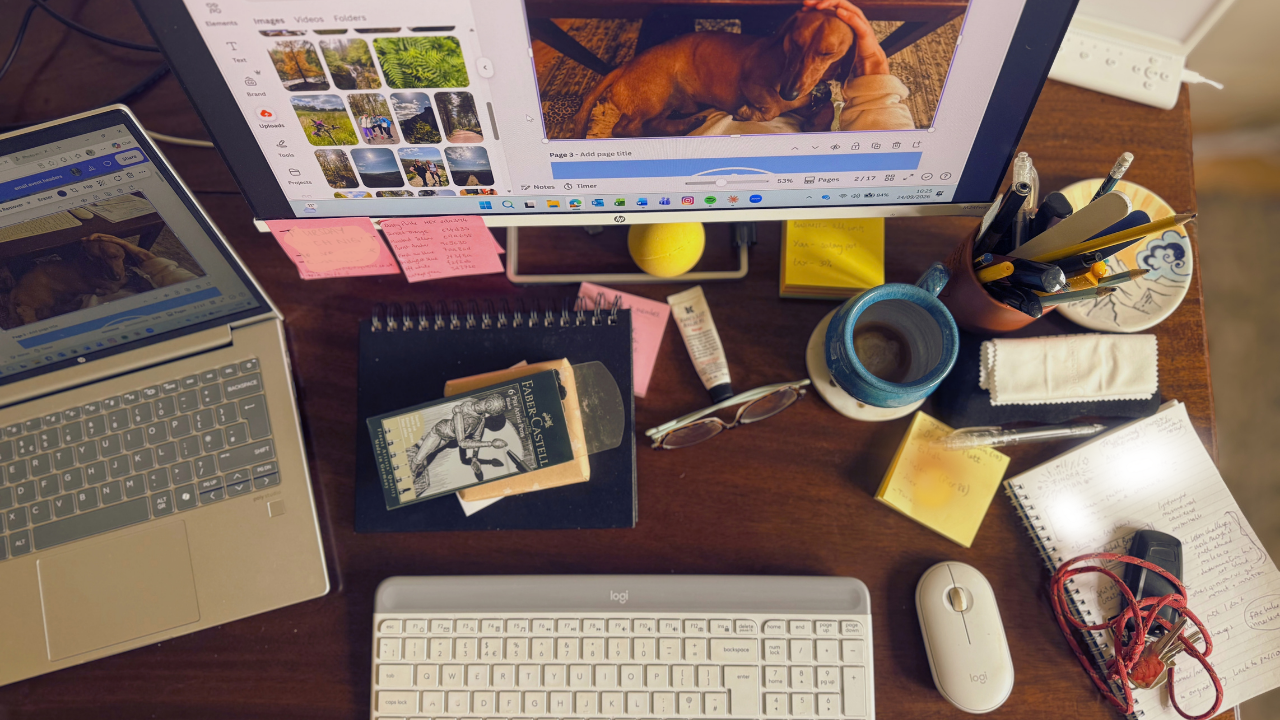
I was speaking with a fellow female founder today and this theme came up: true practical resilience versus simply trying to do it all without asking for anyone for help. Picture it. A home office piled high with to-do lists, an inbox overflowing with noise, meetings booked back-to-back, a dog that needs walked and a washing machine beeping that it's finished and needs dealt with. Then there's the background noise of everything else: ageing relatives to check in on, the evening meal to plan, people to ferry to wherever they need to be later. You're bone tired.
It's no wonder you feel stressed and that you've been this way for so long the feeling has become your new normal. The notion of resilience to stress has become this epic peak we are constantly striving for but never quite reaching. Ironically, even being resilient has become another chore.
What a stress response actually is
When we are dealing with the idea of ‘stress’ it is almost universally cast as the enemy, but I think it’s important to note that it is something we need in our lives to perform to our best abilities. I want you to be able to separate out the good stress from the bad stress and what each of these things does to your biology.
Firstly, let’s quickly breakdown what stress is. When we see a ‘stressor’ (read: snarky email from boss, temporary traffic lights when we’re running late) we have a ‘stress response’ (read: physiological changes to our heart rate, breathing, blood pressure, pain threshold, immune response, digestion and more). This is all highly normal, healthy even, but not always helpful.
In a true life or death situation this stress response would aid you in evading a dangerous animal for example. We would see the threat; our body would tip into ‘fight or flight’ mode making us hyper focussed, able to tolerate more pain and move faster, all in a bid to help us survive. Then we would *hopefully* evade the danger and once we felt safe again, we could complete the stress cycle coming back to neutral.
When stress never switches off
In modern society, however, the ‘stressor’ or the ‘threats’ are mild and constant, so there is no coming back down or completing the stress cycle. Many women today are walking around in a constant state of chronic stress. This influences your body negatively as you remain constantly switched ‘on’ with a never-ending drip of stress hormones leaking into your system. If left unchecked over long periods of time, this can lead to poor digestion, constant colds, hypervigilance or brain fog, to name just a few symptoms.
The case for good stress
That does not sound like something that can be ‘good’ for us, does it? Not in those terms. But the right kind of stress is something you are in control of. As humans we need stress in our lives to be functional, to achieve things and to feel well in ourselves. A complete lack of stress leads to people feeling underwhelmed, unmotivated and low in mood because there is no pressure to do…well, anything.
So how can stress be useful? Good stress helps us push growth edges and fuels creativity, think of it as a tool that helps you improve: you know that talk you were asked to give that you were nervous as hell to perform? Doing it scared helps you to master more self-confidence, composure when public speaking, marketing and selling what you do. In short, discomfort breeds growth. The important thing to recognise though is that recovery *has* to follow it, and most founders never build in the recovery half of that equation.
How to complete the stress cycle
In the simplest terms, stress management is getting good at relaxing back to neutral after a stress response, a concept researchers Emily and Amelia Nagoski call completing the stress cycle in their book Burnout. Imagine this cycle - we see, hear or even smell a stressor and it will set off a chain reaction meant to protect us and keep us safe. To manage stress day to day, instead of remaining stuck in the middle of this cycle, the crucial piece is finding a way to ‘complete the cycle’ and return to a relaxed, calm state.
As a health coach and certified Lifestyle Medicine Practitioner, I speak to a lot of burnt-out female founders about the topic of stress. And the honest truth? It’s not an easy fix. It requires consistency and an understanding that good stress and bad stress will always be a part of your life. The important thing to do is to learn to recognise your own physical and mental precursors to a stress response and how to create a personalised toolkit to deploy when you notice these warning signs arise.

The fastest way back to calm
My favourite, easy, science-backed way to switch your body from the ‘fight or flight’ (sympathetic nervous system) into ‘rest and digest’ (parasympathetic nervous system) is as simple as they come, just take a breath.
A true, deep breath that expands your belly does several things, it focusses you on the present moment, it gives you time to think rationally about something and crucially, it expands your diaphragm which in turn massages an important nerve that runs through it. This nerve (the vagus nerve) is a direct highway between the gut and the brain and the act of massaging it helps to almost instantaneously tip your body back into ‘rest and digest’ mode.
Just three to five simple deep breaths can help you reset in a moment when you’ve noticed things are beginning to become stressful. If you want a specific technique to practise, box breathing (breathing in for four counts, holding for four, out for four and holding again for four) is a simple, well-studied way to build this into a habit.
Now, it’s clear we live in a new world where mild-moderate stresses are constant. This build-up of micro stresses, if left unchecked, can turn into a bigger problem as discussed above. When I am coaching clients, we work together on catching the signs and symptoms of a stress response early, then learning to deploy something from their toolkit to help ground them. It’s important to have options that work for you dependent on how much time you have or for different situations. Ultimately the body needs to feel safe to relax back to neutral.
So, back to the bit of your business plan you forgot. Managing your stress well isn't about eliminating it, it's about building the recovery in, same as you'd build recovery into any other system you rely on. Breath is one way in, and one of the fastest. Movement and connection are two more, and worth their own conversation another day. You don't need a perfect toolkit. You need one thing that works and the willingness to use it before you're already running on empty.
See you outside.
Stay in the loop
Updates on events, workshops & outdoor adventures.
We promise no spam, unsubscribe at any time.
